Key Takeaways
- Jerome is a thirty-year-old founder who kept hitting the same feeling at every rung of his career — “this doesn’t actually fit” — even after going self-employed was supposed to have fixed it.
- He arrived at the process calling himself a builder, and one question dismantled that label in the first session: given the choice, he picked a clear head over an endless supply of things to build, and he picked it with his gut.
- The real pattern turned out to be gaps: he is most alive when he finds a gap or a challenge and then finds the way through it — a wall other people think can’t be climbed.
- The pattern was there at age five, when he dragged home a branch twice his own weight after being told it wasn’t possible — and it was there the whole time he sold contraband sweets at school with pricing, timing, and supply worked out.
- The proof came from his body before his brain: “I just felt it, like in my belly.”
Why Would a Successful Founder Go Looking for His Why?
Because success hadn’t switched the feeling off. Jerome is thirty, lives in Zurich, and runs a product business he founded with his best friend Laurenz — a friendship that goes back to when they were both three years old. From the outside, the story reads cleanly: he climbed the corporate ladder fast, store manager, then district manager, then a bigger role that brought him to Switzerland. Then he left it all to build something of his own, and the business worked.
But there was a pattern underneath the CV. At every rung of that ladder, after a while, the same signal showed up: this doesn’t actually fit. I don’t feel like I belong here. Going self-employed seemed to cure it. Having something that was actually his gave him a fire the corporate track never had.
Three years in, the signal came back in a new shape. A product launch went wrong, the early months of the year were brutal, and he caught himself sitting in front of a computer all day asking whether he still wanted this in ten years. His own words from the pre-work: “I recognised the pattern repeating and wanted to actually understand it this time, instead of just switching to the next thing and hoping it fixes itself.”
That’s what he came to do.
What Did Jerome Think His Why Was?
Building. It’s the obvious answer, and he had the evidence to back it. His most alive stretch of the year was two weeks spent on a new business concept in his supposed free time — mornings, evenings, weekends — an idea that kept pulling him back without him forcing it. His peak moments were all construction: developing the water bottle idea with Laurenz in the evenings next to his day job, months spent mapping a messy business into clean documented processes, the new concept he’d torn down and rebuilt five times without ever feeling stuck.
A founder who feels most alive when he’s building. It fit the facts. It fit the identity. It’s the answer almost any entrepreneur would give.
It lasted one session.
What Question Broke the Builder Label?
A forced choice: a permanently clear head with nothing to build, or endless new things to build in a permanent mental fog. Jerome sat with it — it wasn’t easy — and then chose the clear head. Not with logic. He said afterwards the ranking came “more in feeling.”
And that answer rearranged everything. Because if building were truly the right instrument for him, no fog could stop the music. What Jerome actually said, working it out in real time, was this: “I thought building… but maybe I need the clarity to really be in the progress of building.”
So we pulled the thread. The thing that mattered most? Seeing a real gap. It’s the click when the dots connect. Jerome could point to it everywhere. The concept that got rebuilt five times was five separate clicks — “wow, I got an even better solution,” then two days later an even better one. Every click arrived the same way, in the in-between minutes — a Saturday cappuccino, twenty minutes at lunch, a session at the gym.
What Jerome runs on is finding the gap and finding the way through it.
Where Had the Pattern Been Hiding All Along?
In his childhood, in plain sight. A true Why isn’t built during the process — it’s found, because it was already running long before anyone gave it a name.
At around five years old, Jerome found a branch he wanted to bring home. It weighed twice what he did. His parents told him it wasn’t possible. He dragged it home anyway. Around the same age, he wanted an ice cream his parents wouldn’t buy — so instead of giving up, he spotted the ice cream vendor struggling to push his cart up a dune, ran over and helped, and was handed an ice cream without asking.
Then the clearest one. At school, pupils weren’t allowed to leave the grounds to visit the supermarket during breaks. Jerome went anyway — he just made sure not to get caught — filled his backpack with sweets, crisps and drinks, and sold them to classmates at three times the price, because nobody else dared take the risk. He got systematic about it: shopping before school started so the stock was ready the moment the break began. Pricing, timing, supply. A blocked path – a gap – and a structured way through it.
Twenty years later, after the failed launch, Jerome spent weeks connecting dots to find a way to solve a problem that every seller in his market runs into — one that works entirely within the platform’s rules, where everyone else had assumed the rules were a wall. When we laid the two stories side by side, they were the same shape. The rule was never the stopping point. The rule was the starting gun.
It shows up everywhere once you see it. Laurenz once told him a competitor’s patent made their product impossible — Jerome went day and night through suppliers and patent lawyers and came back with their own patent filed. His fiancée said there was no way to get tickets to a sold-out concert the day before the show; he found them in fifteen minutes, purely because everyone said it couldn’t be done. His own summary: “What switches me on is a wall other people think can’t be climbed.”
How Do You Know the Statement Is Right?
The body votes before the mind does. When we tested a scenario where all the draining execution was taken off his plate, leaving only the solving, Jerome didn’t analyse it. “I just felt it, like in my belly, like positive.” That became the standard for every version of the statement that followed — not agreement, the belly.
He read the statement aloud over several days, morning and evening, and watched what it did to him. His description of it settling in is one of the best we’ve heard: “In the beginning it was more like a birthmark I never really recognised, although I knew it’s there.”
There was one last refinement Jerome made. A late version of the statement included proving that the solution works — and he pushed back on his own statement, because when he ran back through every moment of his life, the proof wasn’t always there. The drive to prove himself is real, and it intensifies things when it’s present. But it’s a condition, not the core. A statement without its conditions is half a Why — and a condition smuggled into the statement makes it less true. So it moved out, and what remained was the sentence that held against every piece of evidence from three decades:
Jerome is most alive when he finds a gap or a challenge and then finds the way through it.
We pressure-tested it against everything he’d given us. It didn’t break.
What Can’t the Why Do?
It can’t tell him when to stop. This was the last discovery we made. In the final exercise, Jerome wrote two versions of how the people closest to him would describe him — one if his life ended today, and one after a life fully lived. The gap between the two wasn’t about gaps or challenges at all. It was about presence. The Why generates the drive, the solutions, the energy — it always has. What it will never generate by itself, in his words, is “when to stop, when to be fully present instead of chasing the next gap.”
That’s not a flaw in the statement. It’s what the statement makes visible. Knowing your instrument also means knowing what music it can’t play — and building the protections around it deliberately: the anchors, the recovery, the evenings that actually belong to the people he loves.
What Changed?
He started restructuring his week within days. Mornings blocked for solving, before the inbox gets a say. A plan to hand off the execution work that drains him. The statement written down where he can see it — and a second version in German, his first language, because a Why should ring true in the words you think in.
And the pattern that started this whole search — this doesn’t actually fit — finally has an explanation. It was never the jobs. It was that every rung of the ladder handed him less finding and more maintaining. Now he knows exactly what to point his weeks at: the gap, the wall, the way through.
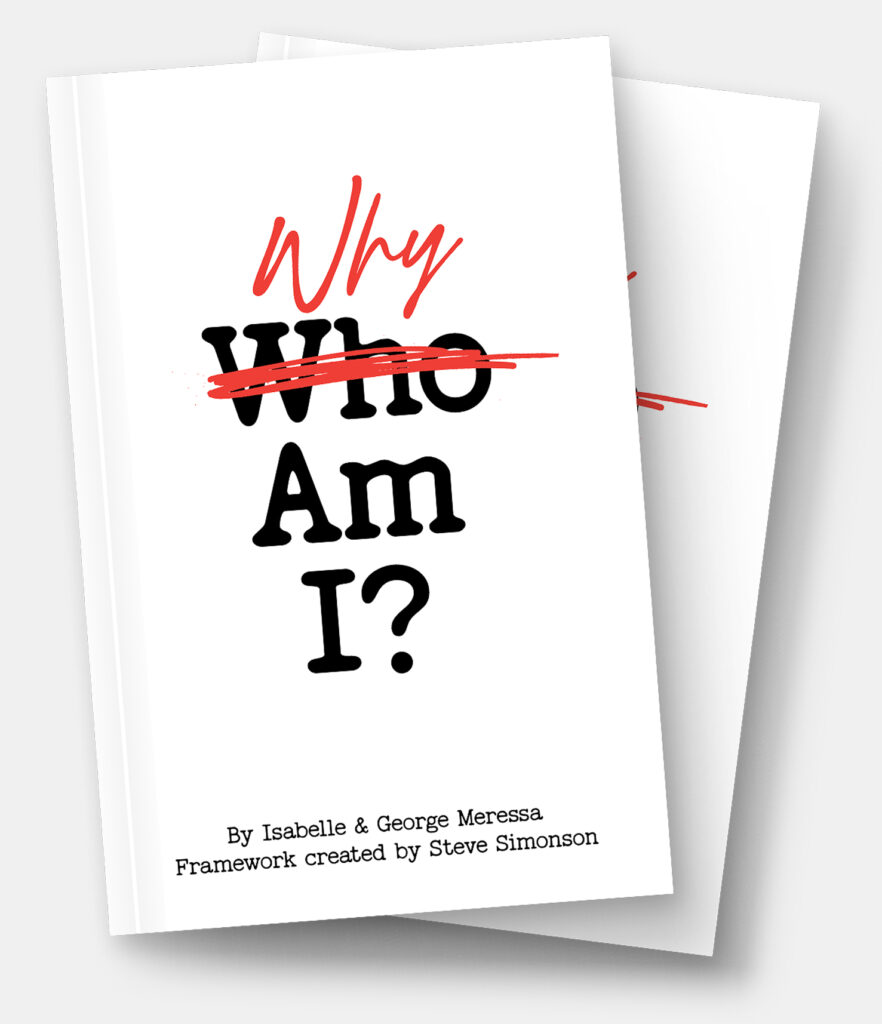
Jerome went through this process after the book was written, so his story isn’t in it — but the process that found his Why is, step by step. Ten other people’s journeys run through its pages, from a pastor to a charity worker to founders like Jerome, each ending somewhere completely different. If you’ve ever given yourself a label that never quite explained your energy, Why Am I? will show you how to test it. If you haven’t read it yet, start there.