Key Takeaways
- Josh had been handed the Why process once before and he parked it. This was not from laziness, but because the task was vague, had no defined endpoint, and came with no examples, which for a man who runs on definitive outcomes made it the one problem he couldn't get hold of.
- His peak moments all shared the same shape: alone, usually at 3:00 a.m., taking apart a complex system. From Bitcoin cryptography, betting-site mechanics, financial instruments from a film — until it made sense.
- The first serious statement, "I need to understand how things work, and when they don't make sense I won't stop until they do," sounded exactly right until Josh himself dismantled it, testing it against a dozen real moments and finding it failed more than half of them.
- What the failures revealed: understanding is his method, but the advantage is the fuel. He goes deep only where he can see a disproportionate future benefit, which is why he'll master a warehouse system nobody asked him to learn and cheerfully refuse to learn where countries are.
- His Clifton top five, taken independently, converged on the same answer. One blend description reads almost like his finished statement in Gallup's words.
Why Did the Why Process Fail for Josh the First Time?
Because it was the one problem in his life with no defined shape. Josh runs an e-commerce business, and his mind works on definitive outcomes: a task should have an endpoint, a milestone, a way of knowing you've won. When the Why process first reached him a couple of years ago, he didn't resist it — he simply couldn't get hold of it. The work felt vague. There was no template of what a finished Why even looked like, no examples to gauge his output against, and no guarantee that hours of homework would produce an answer at all. So he parked it, and life carried on.
By the time we picked it up together, his diagnosis of that first failure was precise, as everything with Josh is: what had been missing were reference points. "If I could redesign the process," he said, "I'd hear the Why of as many other people as possible" — because you can't gauge your answer against nothing. So this time we started there: a real example of a finished Why, a defined structure, and a schedule he chose himself — sessions packed into consecutive days, because Josh likes to get to the answer fast.
He was also, by his own admission, not in crisis. Things were good. Which makes what the process found more interesting, not less.
What Were His Peak Moments Hiding in Plain Sight?
A pattern so consistent it was almost embarrassing: every single one was Josh, alone, in the small hours, taking a system apart. He stayed up past 3:00 a.m. learning how Bitcoin encryption works — not to trade it, at first, but because a video about cryptography had shown him something he couldn't yet understand, and that was unbearable in the best way. He watched The Big Short and couldn't sleep until he'd taught himself synthetic swaps and CDOs, because the film had moved faster than his understanding. At university he fell down the rabbit hole of matched betting, and when the obvious routes ran dry, he mapped the entire network of bingo sites running on the same software platform and worked through them systematically — not gambling, but operating a system he understood better than the people who built it.
Even the outlier fits. Faced with a speeding fine, Josh noticed an inconsistency in the paperwork, taught himself the relevant corner of criminal procedure law, found that the rules hadn't been followed, and represented himself in court. Hiring a solicitor would have been faster and probably cheaper in opportunity cost — he admits that freely. But the system had a hole in it, and he'd seen it, and that was that.
Five moments, one shape. No colleagues, no audience, no clock. Just Josh and something opaque, worked at until it went clear.
What Was the First Statement — and Who Broke It?
The first serious statement was: I need to understand how things work — and when they don't make sense, I won't stop until they do. And the person who broke it was Josh.
The early hypothesis had been "decoding complexity," and it resonated — but Josh's first response to it was pure Josh: isn't that just what I'm good at? A Why isn't a skill. So we refined it, and the refined version felt stronger. It explained Bitcoin. It explained the deep dive into every mechanism of the Amazon system while others just fix what breaks. It explained the moment at a previous job, at Nike, when his manager pointed out that within a year Josh understood their internal operations software better than people who'd used it daily for a decade.
Then we gave him the statement to pressure-test against his own life, moment by moment — and he audited it the way he audits everything. Did it explain why he left a stable accountancy career to build his own business? No. Did it explain several of the times he'd stepped in to help someone? No. Did it explain the shortcuts he'd engineered as a student? No. He worked through the list, marked each miss, and delivered the verdict in writing at the bottom of the page: "I don't think this current why is accurate."
What Was the Statement Missing?
The music. The failures all pointed the same direction: understanding is Josh's method, his instrument of choice, but it was never the thing that made the music. What actually drives him is the advantage on the other side of the understanding — the disproportionate future benefit that depth unlocks.
Once you see it, it explains everything the broken statement couldn't, including the things Josh refuses to learn. Geography, famously: he is, by his own cheerful admission, terrible at knowing where countries are, and completely untroubled by it. "I'm not a pilot," he says — "why would I need to know? I'm not driving the plane!" It's complex enough, it's basic general knowledge, and there is no edge in it, so it gets nothing. The YouTube algorithm, meanwhile, he reckons he'd happily learn to a top-one-percent level — but only if he wanted to win on YouTube. The complexity is the same. The difference is whether there's a game worth winning.
And the advantage doesn't have to be money. At Nike there were no loopholes in that warehouse internal operations system, no exploit to find. But understanding it meant a task that took colleagues three hours could take Josh ten minutes — and watching people click through the same screens for ten years without ever asking how the machine worked was, to him, genuinely baffling. He went just as deep on pizza dough after buying a pizza oven, for no financial return at all. The benefit there was simpler: if he's going to make pizza, mediocre pizza is a terrible outcome. Why put in all that effort and expense to end up with a mediocre output? For Josh, it's not worth doing.
What Did the Final Statement Become?
I go deeper than anyone else because I know that depth creates advantages others can't see.
When we put that version in front of him, it landed differently from every previous attempt — and true to form, Josh tested it before accepting it. Would he learn a complex system inside-out if the knowledge could never be used for anything? "Pointless," he said. Would he take a ready-made playbook and skip the understanding? Closer — but he'd then pull the playbook apart, understand why it worked, and push it further than the person who handed it over. That's what he'd done with every system he'd ever been shown: understood it, then scaled it past its original limits.
The conditions came into focus alongside it. The problem needs real complexity — layers, where each answer opens another level down. He works alone; understanding, in his words, has to happen internally first, and only then can it be shared. There can be no clock on it — which finally explained why chess, an obviously Josh-shaped game, stresses him rather than feeds him: there is a single optimal move, and never enough time to find it. And the problem has to be solvable, with a definitive endpoint — he can accept an impossibility if you prove it to him, but he can't accept vagueness.
Which, incidentally, is the full explanation of why the process failed the first time. It wasn't the wrong task for Josh. It arrived violating three of his four conditions.
What Did the Clifton Strengths Results Add?
Independent confirmation, in someone else's vocabulary. Josh had taken the Clifton Strengths assessment separately, and his top five came back: Input, Competition, Achiever, Futuristic, Restorative.
Read against the finished statement, the convergence is hard to dismiss. Input is the collector's strength — the drive to gather information and file it away, trusting it will prove valuable one day. Competition is the need for an edge, measured against others. And Gallup's own description of how those two blend together could sit in Josh's slide deck unedited: "a competitive edge because you gather useful resources" — depth as the route to advantage, in nine words. The remaining three fill in the rest of the picture: Restorative is the pull towards finding what's wrong and fixing it; Futuristic is a mind that lives in the payoff still over the horizon — the disproportionate future benefit that decides where Josh's depth gets spent; and Achiever is the stamina that keeps him at a problem at 3:00 a.m. long after everyone else has stopped.
Five strengths, measured by a standardised assessment with no knowledge of our sessions, describing the same person the sessions found. That's what convergence looks like — and it's why the assessment sits in the process as a cross-check rather than a shortcut.
What Changed?
He can finally explain his own filter — and he's still testing the statement, because of course he is. Josh described the discovery itself as naming something he'd always mislabelled as "general learning": the realisation that not everyone is pulled the way he's pulled, and that the pull has rules. He knows now why he walks straight past some complex problems and disappears into others for a week. He has a clean answer to the question that used to have none — what a Why even is. His definition, coined mid-session, is the best one-liner the project has produced: a Why is your innate compulsion. And he has a measure for decisions that beats intellectual agreement: does the thing fill you with energy, or drain it?
But the most fitting ending is this: Josh doesn't consider the statement finished. The man who wouldn't accept the first answer on Bitcoin, on betting systems, on a warehouse tool, is not about to accept the first workable answer on himself. He took away the full set of transcripts to keep refining it in his own time, at his own pace, alone — no deadline, no clock, a definitive endpoint he'll recognise when he reaches it.
Which is to say: the statement is already true. He's going deeper than anyone else on it.
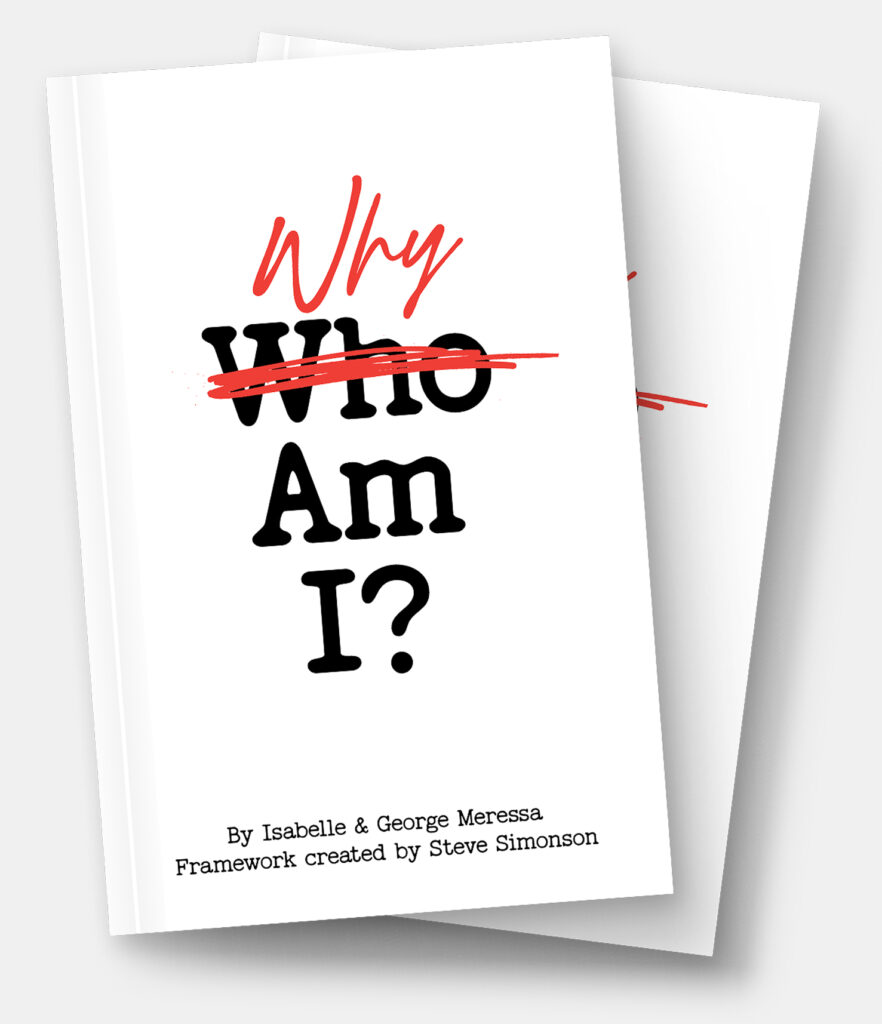
Josh's story runs through Why Am I? alongside nine others. The thing he said was missing the first time round, the reason he parked the process for two years, was examples: real people, real statements, something to gauge your own answer against. The book is exactly that — ten finished journeys, and the full set of exercises in the order Josh worked through them. If a vague question has ever made you shelve an important one, start there.