Key Takeaways
- Laurenz had been hunting his Why for two years before this process, working through the framework alone and getting answers that, in his own words, felt too intellectual and too surface-level.
- The three peak moments he arrived with — a degree he nearly failed, a driving licence he nearly failed, and the day he quit his job — were real, joyful, and useless. Anyone would have felt exactly the same.
- The answer was not found by digging deeper into those moments. It came from going wider: thirteen small, unimpressive ones instead, including planning his week, reading a Saturday newspaper, and six hours teaching himself a piano piece.
- Laid side by side, seven of them began with almost the same sentence — the moment it all came together. That repetition was the fingerprint.
- The half of his Why he cannot live without turned out to be the half nobody would have guessed: not the working it out, but the handing it over.
Why Would Someone Spend Two Years Looking for Something He Already Half Had?
Laurenz is thirty. He lives in the centre of Zurich with his wife and a six-month-old dog, and he runs an e-commerce business he founded in 2022—his best friend since they were small boys in the same village. He rates his life an 8 out of 10 and means it. By the usual measures, this is not a man in need of rescuing.
But he had been circling the same question for two years. He first heard Steve Simonson describe the Why on a live call, worked through the framework several times, and wrote several versions of his own statement. His verdict on all of them was the same: “Each time I got a little closer, but I never felt I had reached the core of what truly motivates me. My answers still felt too intellectual and too surface-level.”
What Do You Do When Someone’s Best Moments Don’t Count?
He arrived with three. The first was finishing his bachelor’s degree — a genuine triumph for someone who had struggled academically since primary school, who had been sent to boarding school after missing the grades, and who once stayed behind while the whole year moved on without him. He walked out of the final oral exam, got into his car, drove home with the music loud, and cried.
The second was passing his driving test at eighteen after failing two practice tests. The third was the June morning in 2023 when he told his team leader he was leaving a safe corporate job to go all in on the business. His body was shaking afterwards, and he had no doubts at all.
Three good moments. And not one of them could tell us anything about Laurenz.
There are two kinds of joy in this work, and only one of them is useful. If you struggle at something for years, fear you will fail, and then succeed, you will feel euphoric and so would anyone else in that position. The longer the struggle, the bigger the feeling. Don’t get me wrong, that joy deserves to be celebrated, and it identifies nobody, because it belongs to everyone. What we are hunting is the thing that fills you and would leave the person next to you cold.
His own summary of his pattern, written before the first call, said it perfectly without meaning to: “There was always resistance, pressure, or a bad feeling — I might not make it — and then it turned into success.” True. Also a description of being a human.
The holiday in Greece went the same way. Two weeks with his wife, finally able to switch off, the business running without him. Restorative, and exactly what anyone would feel after a long stretch of work. It stayed out of the evidence.
Which left the first session in an unusual place. Normally this process finds a wrong label sitting on top of real evidence and knocks the label off. Here there was nothing to knock off. The table was empty.
Where Do You Look When the Big Moments Are No Help?
You go smaller, and you go wider. The weekend homework was not to think harder about the three moments he had. It was to find fifteen more and not analyse any of them and just name each one, describe it in three lines, and say which exact minute of it filled him. At least four from before his working life. At least three that felt trivial. And a specific instruction not to filter for the theory we were already carrying, because a moment that fits nothing is worth more than one that fits neatly.
They were, by any normal standard, unremarkable. Reading a proper newspaper for two or three hours on a Saturday morning and disappearing down a rabbit hole about the alcohol-free wine market. Planning the week ahead on a Sunday evening. Rebuilding the company’s inventory tracking with AI he had never used before, until the whole team could read it at a glance. Cooking a meal for people he loves. Planning a perfect day in Zurich for friends who are visiting. Buying a camera on a supplier trip to China and filming everything. Chess. Six hours at a piano piece he could not read the music for, taught to himself off videos, until it suddenly clicked.
And one from twenty years earlier. At sixteen, at boarding school, after a year of clashing with a teacher, he was given a final chance: one week to turn thousands of photos and videos from the group’s year — the Himalayas, Nepal, the volunteering, the living on top of each other — into a documentary for the whole school. He had never edited video in his life. He downloaded the software, taught himself, and worked four days and nights on almost no sleep.
The moment he named as the alive one is not the screening. It is this: “The moment I figured out how to turn thousands of scattered photos and videos into one coherent story.”
The Seven Sentences That Gave It Away
Individually, none of those thirteen moments proves anything. Stacked, they stop being a list and start being a fingerprint. Here are the alive minutes, in his words, one after another:
The moment I figured out how to turn thousands of scattered photos and videos into one coherent story. The moment the plan is complete and every priority has its place. The moment all the pieces come together into one clear story. The moment everything is organised and I have a clear plan. The moment the dashboard started making everything clear. The moment the plan comes together and I can picture the whole experience. The best part was the moment I realised I had figured it out.
It had been sitting there in plain sight the whole time, in a man who had spent two years convinced his answer was something to do with overcoming obstacles.
It is worth saying that it did not land instantly. On the Monday morning call it had not yet clicked, and rather than push on and force a pattern, we stopped and rebooked for lunchtime. The reading needed to happen properly before the questions could be any good.
By that afternoon there was a loop in three beats. Something scattered grabs his attention. He works it until it clicks into one clear picture. Then he hands it over so someone else can understand it and carry it forward.
Which Half Could He Live Without?
A statement is only worth having if you have tried to break it, so we went after both ends of the loop.
First the handover. Take the alcohol-free wine market. You research it, you understand it completely, it clicks — and then you may never tell a single person about it, never use it, never build anything on it. Still fills you? “No, would not fill me.”
Then the other end. Your business partner walks in with the whole thing already solved — the market gap, the fit, the strategy, finished — and your only job is to make it clear enough for the team to run with. “Yeah, I like that. It would fulfil me.” He would rather find it himself. He does not need to.
So the beat everyone would assume is the point — the digging, the figuring out, the click — is negotiable. The beat that looks like an afterthought is the one he cannot do without.
Once you see that, the whole history rearranges itself. The four sleepless nights at sixteen ended with the film being shown to the school. The China trip footage went to an editor and came back as something other people could watch. He admits he would not have made those vlogs for his eyes only. Even the Saturday newspaper has a handover hidden in it: the alcohol-free wine becomes the interesting thing he brings to a conversation later. And the products at his ecommerce store: the water bottle with a unique feature was his business partners idea, thousands of loose details, and Laurenz’s part was placing every piece for the suppliers, the marketing, the team. His description of that work is “a really joyful work for me.”
The last test was a whole week, eight until six, of nothing but taking scattered things, making sense of them and presenting them. “It would be energising to me.”
Why the Real Version Is in German
When we put two draft statements in front of him, he picked the shorter one — then read it again properly and changed his mind, because the shorter one had dropped the handover. “This is more like the pattern,” he said. “You’re right.”
But the sharpest version was never in English. Asked to write it as he would actually say it, he reached for a German verb the English drafts had been circling for two days: vermitteln. It carries conveying, explaining and mediating in a single word. A whole handover in one verb, where English needed a clause to say the same thing badly.
The statement he keeps is the German one: Ich bin am lebendigsten, wenn ich mich in etwas vertiefe, das wirklich wichtig ist, bis es Klick macht — und es dann so vermitteln kann, dass andere es verstehen und selbstständig weiterführen können.
In English: I am most alive when I immerse myself in something that matters until it clicks — and can then convey it so clearly that others understand it and carry it forward on their own.
He wrote it out, slept on it, and read it again the next morning. It came back a nine out of ten. Not a goosebumps moment, and we did not pretend otherwise. The one thing holding it off a ten was, fittingly, the question he had been trained all week to ask: “My only question is whether it is already specific enough to be truly unique.”
What the People Closest to Him Couldn’t See
Three people were asked two questions with no context: when do you think I am most alive, and what am I naturally best at?
His younger sister said he is good at communicating and expressing himself, at keeping the atmosphere peaceful, at lifting a mood and making people laugh. His wife said he is willing to compromise, handles problems calmly and without too much emotion, and is very good at organising things.
Every word of that is accurate. Every word of it is also beat three. Nobody described the part where he disappears into something scattered until it clicks — because that part happens silently, in a deep work block, on a Sunday evening, behind a newspaper.
This was his reaction: “I was surprised that no one mentioned my ambition, business, or achievement. Instead, they focused much more on how I make people feel.”
This is worth knowing about the exercise generally. The people who love you can usually describe what your Why produces. They often cannot see what produces it. What they gave him was the output, described from the outside, by people who had never been told there was anything to look for.
What the Strengths Assessment Could and Couldn’t Tell Him
His Clifton top five came back Developer, Positivity, Empathy, Strategic, Achiever — four of the five reading distinctly people-shaped. Read cold, you would hand him a Why about people, which is exactly the answer this process spends its time dismantling.
Read against the statement, it splits cleanly in two. Strategic is a mind that sees the pattern where others see chaos. Achiever is what keeps him at a thing until it clicks. Developer is the pull towards leaving someone better than you found them — the architect he turned into a supply chain manager over eighteen months, and his summary of why that mattered: “I can give something to somebody and the person or the system is going better afterwards.”
Empathy and Positivity are not the source. They are what make the handover his rather than anyone’s: he is not simply passing information across, he is watching whether it landed. Laurenz spotted the tension himself before we did — he had expected empathy to be all over his peak moments, and it barely appeared. It does not appear because it is not the thing that fires. It is the thing that makes the firing worth watching.
Meanwhile Gallup’s notes on his Strategic talent describe someone who lays ideas out in order, reaches for stories and examples to show people what he means, and gets handed the job of turning a plan into steps others can follow. That is the third beat of his loop, written by a questionnaire that had never met him.
What Changed?
He put a number on the damage first. Roughly 30% of his working week goes on the things he has now named as the killers: deep technical detail, operational execution after the decisions are made, busy work that shows no progress, and small unimportant emails. The technical detail was the surprising one — the patent work on their first product, thousands of drawings, arguing about airflow through a filter. His description of what happens is precise: it stops clicking, and once it stops clicking he does not want to go further.
That work has an obvious home. His business partner runs on exactly the kind of wall Laurenz wants to hand over, and after four years of doing this instinctively they finally have language for it: His business partner finds the gap and the way through, Laurenz takes the nearly-complete thing and makes it something a team can carry. Two friends from the same village, accidentally complementary, now able to say so out loud.
The rest is small and practical. Unimportant tasks cleared for a fortnight to make room for structural thinking. Deep work pointed at what actually fills it — new frameworks, other people’s processes, scattered sources pulled into something the company can use. The statement on a whiteboard above his desk, in German. Each day’s activities scored from minus three to plus three, to find out where his energy really goes rather than where he assumes it goes.
And a fair warning for anyone expecting a tidy ending: this one does not have one. He asked, in the final minutes of the last call, whether his Why was still too universal. It is not — the sharing is what makes it his. But a nine is a nine, and the real test is the next few months, not the last week.
The last thing worth noting is where he found the loop running at its purest. Not a launch, not a negotiation, not a win. His weekly planning, on a Sunday evening, when everything loose finds its place and he can see the week whole. His words: “This is the best part of the week.”
For two years he had been looking for something that felt big enough to be an answer. It had been in his calendar the whole time.
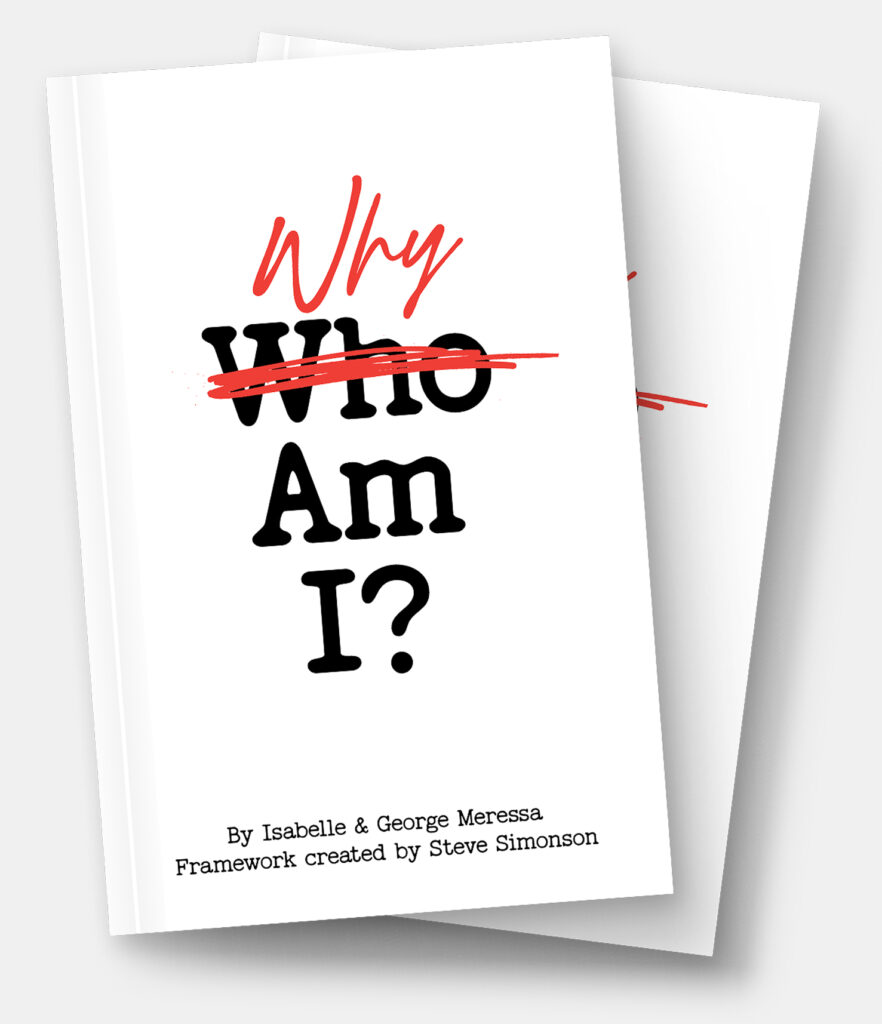
Laurenz went through this process after the book was written, so his story is not in it but the process that found his Why is, exercise by exercise, alongside ten other people who each ended up somewhere completely different. If your own list of proudest moments is full of hard things you eventually got through, Why Am I? will show you why that list cannot answer the question, and where to look instead. If you haven’t read it yet, start there.