Key Takeaways
- Tham arrived having already read the book, carrying two Why statements of his own, and his verdict on both was that they sounded right but could have described almost anyone.
- His analytical mind could make nearly any theory fit his life, so when all twenty-one of his moments fitted the first theory, the process had to start building tests designed to break things instead.
- He dismantled the second theory himself, showing that even a room full of brilliant people would leave him restless if nothing in it was growing.
- A habit he had spent years calling impatience turned out to be the clearest pattern in his evidence: he comes alive watching potential surface in small movements, in other people and in himself.
- His strengths assessment, completed weeks before his first session, described that same pattern in almost the same words.
- His working statement now exists in English and in French, the two versions say slightly different things, and the moment of recognition the process waits for has not arrived yet.
Who Is Tham, and What Was He Looking For?
Tham was looking for a compass, a way of choosing what to do next that relied on something steadier than instinct or other people's approval. He is in his early thirties, and his life so far has crossed three countries and four languages. He grew up in Tunisia, then spent ten years in Quebec building a career in tech sales that took him all the way to sales director. After that he left, and spent ten months travelling through twenty countries on four continents.
He now lives in Spain, where he has spent the past year experimenting with consulting, coaching and building his own software. Arabic is his mother tongue, French is the language he says he is most fluent in emotionally, and English follows closely behind. Spanish is his fourth language, and one he is still actively improving.
He was not in crisis when he started, and he was very clear about what he wanted from the process. In his own words from the first pre-work: "finding my Why will help me choose my next experimentations more rationally and more naturally. It will also give me a compass to guide me through their execution as well, instead of just relying on my instincts in real time or on people's validation to define success."
What Was Wrong With Statements That Sounded Right?
Nothing was wrong with them, except that they could have belonged to almost anyone, and Tham was the first person to say so. He had read the book before the sessions began and arrived with two versions already written. One said he was most alive when removing new and meaningful obstacles for himself and others by learning how to do it curiously. The other said he was most alive when curiously figuring out answers to new and meaningful problems, for himself and others.
His first pre-work asked him to set both versions aside, gather evidence from his whole life for two weeks, and only look at them again at the very end. When he finally reopened them, his conclusion was honest and precise: "Both the previous Why statements and the new one I came up with seem good and sound coherent, but they don't feel specific enough. They all can apply to a lot of people, and they don't generate a particular 'that's it' effect on me."
In the first session he put the same thing more simply. "Definitely work in progress," he said. "I feel like coming from my brain, not from my heart."
That sentence set the shape of everything that followed. The standard this process holds to is a physical response, the moment a statement lands somewhere below the neck before the mind has finished agreeing with it. A statement can be accurate, carefully built and fully agreed with, and still fail that test, because agreement is something that happens in the head.
Why Was It a Problem When Every Moment Fitted?
Tham's mind is good enough at making ideas work that a theory fitting his evidence proved almost nothing on its own. He describes himself as an analytical person and a natural devil's advocate, and he explained his method plainly in the first pre-work: "if I can't find an exception that negates this principle, then I can agree with it." That is a rigorous way to test an idea, but it carries a quiet weakness, because a mind that hunts hard for exceptions can become equally skilled at absorbing them.
The first serious theory surfaced late in the opening session. Tham had described a childhood spent for hours on a play mat printed with an entire city, inventing the relationships between its tiny inhabitants and imagining how each of them thought. He remembered teenage summers in his uncle's hydraulic hose repair shop, asking why each tool was used on each part. Years later, one of his favourite things in his sales career was visiting factories simply to see how everyday objects were made.
When George asked whether all of this was really about people, or about systems he could not see inside, Tham paused on it. "Interesting, in a way of the thoughts of people being systems," he said. "I'm tending to uncover, to understand how they work." Then, without being prompted, he sharpened it further: what fulfils him is discovering a system rather than designing one.
So the next pre-work handed him twenty-one of his own peak moments and asked him to find every one where the systems lens failed. He could not find a single one, and all twenty-one fitted. The note waiting for him at the top of the following pre-work was gentle but direct: "you are good at making an idea work." From that point on, every document was built to make the theories harder to accept rather than easier.
How Did Tham Break the Environment Theory?
He tested it against his own life until it admitted that it was only half of the story. The second session produced a theory that landed harder than anything before it: that Tham is most alive in an environment that nurtures growth, curiosity and energy, where even one genuinely curious and alive person in the room is enough.
The evidence behind that theory reached back across years of his working life. In every job he had, he walked his whole office floor each morning to say good morning to every colleague at their desk, and people noticed quickly on the days he did not come round. He also explained that a single negative person can drain the energy from an entire room for him.
He agreed with the theory, and then immediately put his finger on a resistance to it. "It multiplies my efforts," he said. "I still have some resistance to that idea in itself, because it's removing control from my destiny and delegating it, outsourcing it to the environment and to the soil."
Over the next two days he read the statement every night and every morning and wrote down what his body did with it. His response cooled over those two days instead of warming, which was a finding in its own right. On the first morning he wrote, "Isn't this the case for everyone? Feels too general." By the second night he added that he wished he could use the statement as a compass, and that he could not.
Then came the soil audit, which asked a harder question of every single moment. For each one, he had to decide whether the people around him were the reason it was good, which we called soil, or simply what happened to be around, which we called weather. Most of the moments with people in them came back as soil, but a large group came back as weather, and one of those gave the theory more trouble than all the others.
On silent meditation retreats lasting up to ten days, Tham sat through sessions where the rule was not to move at all for a full hour, three times a day. He shared the room with around fifty other people, and nobody spoke to anyone. He named it as a peak moment because he bore more physical pain than ever before and came out feeling "more able, more resistant, and more powerful." Asked where the soil was in that silent room, he answered in a single line: "I feel the soil here is myself."
The last test in that pre-work imagined the opposite case entirely. He was given a room full of the most alive people he had ever worked with, and work with nothing in it to grow, learn or move forward. Asked to be strict about whether that would be close to perfect, he was clear: "Doesn't seem to be enough. Seems that if we're not growing, accomplishing, learning, or doing meaningful progress, even in the best nurturing environment, it's not fulfilling enough."
What he did with that result matters as much as the result itself. He refused to throw the environment away, because he could see it was doing something real even if it was not doing everything. In his own words, "keeping them in silos would be the trap to avoid here, as it's probably the common point between both of them that is actually the core of my Why statements."
What Had He Been Calling Impatience for Years?
He had been calling it impatience, and it may be the closest thing in his evidence to his actual instrument: he comes alive watching potential surface in small movements. George noticed the pattern before the third session while reading back through Tham's moments, and once it was named it appeared almost everywhere.
In a museum, Tham followed an exercise from a book that asks you to sit in front of a single painting for three hours with no distractions at all. About an hour in, once his initial resistance had faded, he began seeing patterns and details that had been invisible at the start. At university in Tunisia, he helped struggling friends revise before their exams, and the best moment was always finding the image or metaphor that made a difficult concept finally land. He describes that skill with the French word vulgariser, which means making complex ideas simple enough for anyone to grasp.
As a sales director, when he was asked whether the best part of his highlights slide was noticing something or saying it out loud, he answered immediately: "Their faces when I said it." He discovered, after a couple of training runs for a fitness race, that he had never actually hated running at all. Out with friends in Spain, he found himself holding conversations in a fourth language at a level he had not believed he could reach.
Every one of those moments is a movement of the same kind. Something hidden becomes visible, whether it is in a painting, in a friend, in a team, or inside Tham himself.
When George named the pattern, Tham reframed a part of himself he had struggled with for a long time. For years he had read this restlessness "as impatience," and now he saw it differently: "Seeing it from the perspective of needing to see the small movement actually give it a valid reason to exist. Guess I'm looking for the next small movement."
George offered a framing for all of it, an adventure to uncover potential, and Tham met it with less resistance than anything before it. "I love it as a theory," he said. "I don't feel the same resistance I felt with the environment. It feels more aligned now." The final pre-work carried a deliberate caution, though, because the word adventure had come from George rather than from Tham. When Tham sorted the ingredients on his own, he moved adventure into the conditions. The phrase he kept at the centre, uncovering potential, was entirely his own.
Which Language Does His Why Speak?
That question is still open, and it may turn out to be the most important one in his story. In the final pre-work Tham wrote more than a dozen drafts of his own, built from the three ingredients he chose as core: curiosity, uncovering potential, and a nurturing environment.
The third ingredient is a genuine point of disagreement that has not been settled. After the soil audit, we had moved environment into the conditions, and Tham put it back at the centre. His reasoning on the final call was that whenever he sees the word potential in his statement, he sees people in half of it. That call is his to make, and he is still making it.
In English, his working version currently reads like this:
I am most alive when curiously uncovering potential within a nurturing environment.
In French, the version he wrote alongside it reads like this:
Je me sens le plus vivant lorsque je suis ma curiosité pour faire émerger le potentiel au sein d'un environnement nourrissant.
Translated roughly back into English, the French says he feels most alive when he follows his curiosity to make potential emerge within a nourishing environment. The two sentences are close, but they are not the same sentence. In English, curiosity describes the way he does something, while in French curiosity is something he follows. In English, potential is uncovered, while in French it is drawn out until it emerges, slowly and visibly, which sounds a great deal like the small movements he described.
The process asked him from the very first pre-work to write in whichever language a thought arrived in, because the truest word often surfaces in a mother tongue first. Vulgariser had already done work in the opening session that no English word could manage. George's instinct on the final call was that the French version reached further, and Tham's reply was characteristically exact: the two languages do different things, and one cannot be translated into the other word for word.
His own verdict on where the statement stands is the most accurate summary available. "I'm still not convinced exactly of the perfect wording, especially since the French and English versions are different in their formulation, but the meaning/direction in itself is accurate."
What Did His Strengths Assessment Already Know?
His strengths assessment had described the small movements pattern weeks before anyone in the sessions noticed it. Tham completed CliftonStrengths at the end of August 2026, nearly a month before his first session. His top five came back as Empathy, Positivity, Learner, Adaptability and Developer.
Gallup's short description of Developer says that people with this strength "spot the signs of each small improvement." That phrase sits about as close to his small movements pattern as an assessment written by strangers could reasonably get. Learner describes someone excited more by the process of learning than by its outcome, which matches the boredom that arrives once he has found the answer. Positivity helps explain why one negative person can dim a whole room for him, and four of his five strengths fall in the Relationship Building domain, which supports his instinct to keep people close to the centre.
No assessment can name somebody's Why, because these tools describe talents rather than what makes a person feel alive, so it sits in this process as a cross-check rather than a shortcut. With Tham, it confirmed a pattern the sessions had already found on their own.
The people closest to him said much the same thing in plainer words. One of his closest friends, asked without any context when she had seen him most like himself, said: "You're just buzzing, happy. It seems like it crackles positively inside you." What she found unusual was how deeply he listens, adding that "there aren't many people who do that, who listen that much," and describing his manner as "calm, but in strength."
Why Isn't Tham's Story Finished Yet?
The moment of recognition the process waits for has not arrived yet, and pretending otherwise would break the very test this series is built around. George was honest about it on the final call. "We haven't had the aha moment of you yet," he said. "We can see it's taking shape, but there's no aha moment." He added that he could not yet see it in Tham's body, the visible "this is it" that other participants have shown.
That is not for lack of effort, because Tham put more work into his pre-works than most people who have been through this process. What is holding the last step back is a question nobody has been able to answer yet, including Tham himself.
Tham is also openly sceptical of the idea of one permanent statement, and said that what works for him today might not work for him in two years. The framework's answer is worth holding alongside his doubt: the end point a person is heading towards can evolve over a lifetime, while the instrument itself stays the same.
His own end point came through clearly in the eulogy exercise. Imagining what might be said about him thirty years from now, he wrote: "Tham has made so many people shine and thrive. He allowed many of them to find the truth in themselves just by asking them questions and deeply listening to them." His imagined older self also has a favourite piece of advice that he annoys everyone with: "You die the day you stop learning."
George pointed out something striking about the gap between those two pieces of writing. Tham's statement, as he wrote it, barely mentions people, and yet his end point is full of them.
What Happens Next for Tham?
He is putting the introspection down for a while and taking the statement out into the world to see how it behaves. After four weeks of looking inward, he described a real fatigue with self-analysis and a strong pull towards action. He is exploring a few new business ideas, going to networking events and hackathons, and checking his energy after each one to see whether the room filled him up or drained him.
He has also written himself a filter, and it is already doing its job. Asked for the minimum thing that must be true before he says yes to something, he wrote: "A deep interest in the potential of that thing and a real fit with the people to do it with."
Tham's journey continues, and there is still some way to go before it reaches the place this process is aiming for. He will keep both versions of his statement close, read them regularly, and notice which one his body answers to as he lives with them. That could happen within the next few months or it could take considerably longer, and either outcome is an honest part of how a Why is found.
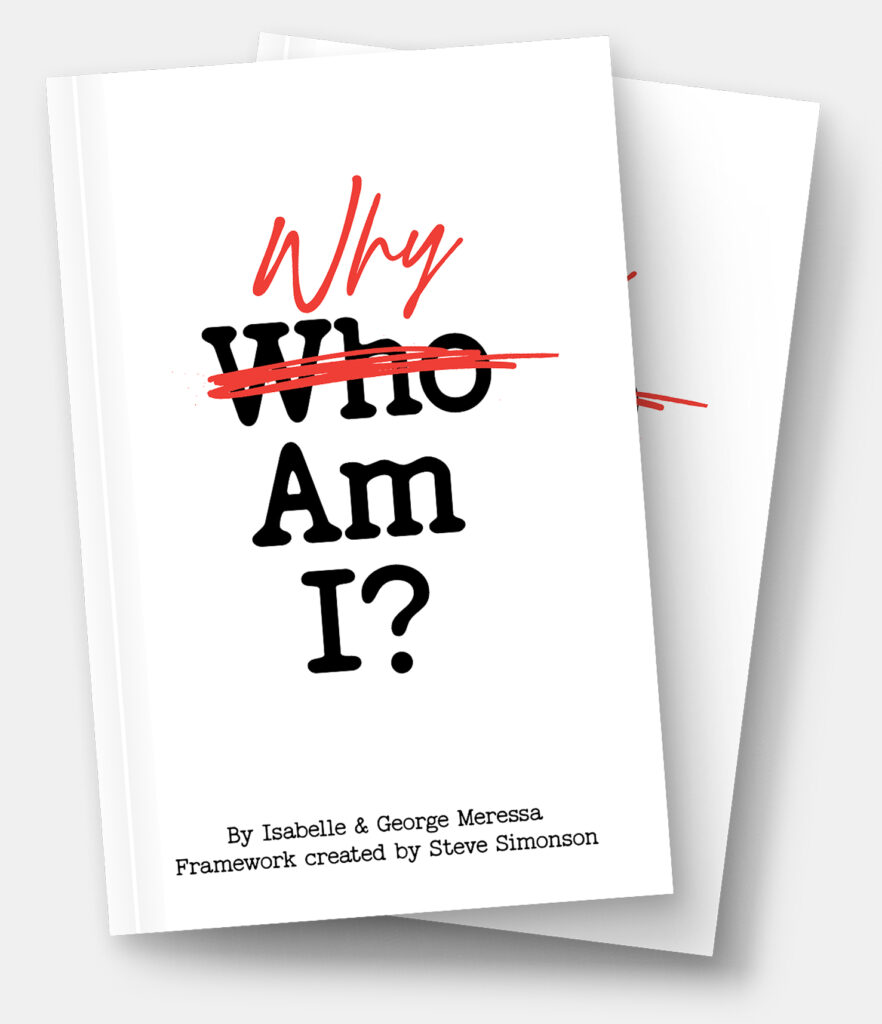
Tham read Why Am I? before his first session, and the two statements he wrote while reading it became the starting point for everything in this story. If you have ever written a sentence about yourself that sounded right and felt like nothing, the book will show you how to start putting it under pressure. If you have not read it yet, start there.